
Dumpster Placement and Driveway Protection in Tyler, TX
How container placement and driveway protection actually work, and what to think about before a roll-off lands on your Tyler property.
ReadSizing guide
The practical version of dumpster sizing — what actually stops a container from being full, and which of the five sizes fits your real project.
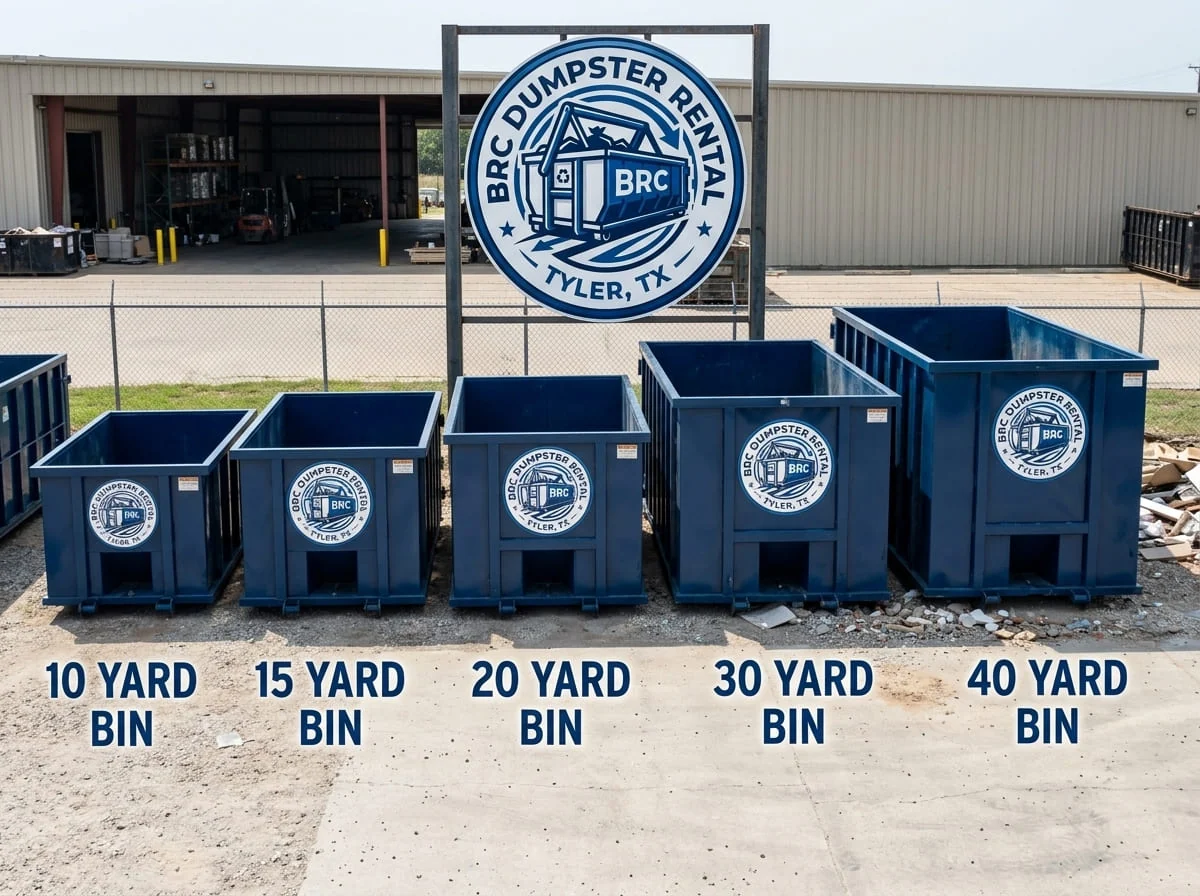
Every roll-off container has two limits: how much it holds, measured in cubic yards, and how much it can carry, measured in tons. Most sizing mistakes come from thinking about only one of those two numbers. This guide walks through both, with real Tyler-area project examples for each of our five sizes.
Bulky, light material — furniture, cardboard, general household junk, construction offcuts — runs out of space before it runs out of weight allowance. Dense material — concrete, brick, tile, wet soil, roofing shingles — runs out of weight allowance first, often while the box still looks a third empty. Sizing on volume alone, without checking what the material actually weighs, is the single most common and most expensive mistake we see.
About 14 feet long, holding 1 to 2 tons. The right call for a single room, a small bathroom remodel, or — just as often — a concentrated load of concrete, brick or fill dirt where a bigger box would only mean paying for unused space.
About 16 feet long, holding 2 to 3 tons. The size most full garage cleanouts, shed teardowns and one-room remodels with flooring land on.
About 22 feet long, holding 3 to 4 tons. Covers a standard single-layer roof tear-off, a multi-room renovation, or a whole-house cleanout before a move. If you are not sure which size to pick and your job is a typical mid-size project, this is usually the right starting guess — though we will confirm with you on the phone.
Same footprint as the 20 yard but taller, adding significant volume without needing extra driveway length. Fits a whole-home gut renovation or a large estate cleanout that would otherwise need two 20-yard hauls.
Our largest container, built for bulky light debris rather than dense material. Right for commercial demolition and large-volume, lower-density loads — wrong for concrete, which hits the weight limit long before the box fills.
A single-bathroom strip-out in an older Azalea District home: 10 yard. A garage cleanout in a Whitehouse subdivision: 15 yard. A single-layer roof tear-off after an East Texas hailstorm: 20 yard. A whole-home renovation in a historic Tyler property: 30 yard. A commercial retail build-out along Loop 323: 40 yard.
Talk to a real person
Call (903) 515-5086 and describe the job. Flat price, stated tonnage allowance, and a delivery window on the same call.
Mon–Sat 7:00am – 7:00pm
From this guide
A 20 yard covers the widest range of typical projects — a standard roof tear-off, a multi-room renovation, or a whole-house cleanout. It is the size most Tyler-area jobs land on.
Dense material like concrete hits the weight limit long before it fills a larger box, so a smaller container is often the cheaper and more correct choice for anything heavy.
Not necessarily. It is a volume container built for bulky light debris, and filling it with dense material is neither legal to lift nor cost-effective. Describe your load and we will size it correctly.
Yes, if the size turns out to be wrong. It costs another haul, so getting it right the first time by describing your project accurately saves you that extra trip.
Keep reading
How container placement and driveway protection actually work, and what to think about before a roll-off lands on your Tyler property.
ReadTyler's identity as the Rose Capital of America comes with a real gardening culture — here is how seasonal yard and garden cleanup actually gets sized.
ReadWhat actually drives dumpster rental pricing in Tyler, and the real ranges you should expect for each size before you call around.
Read